
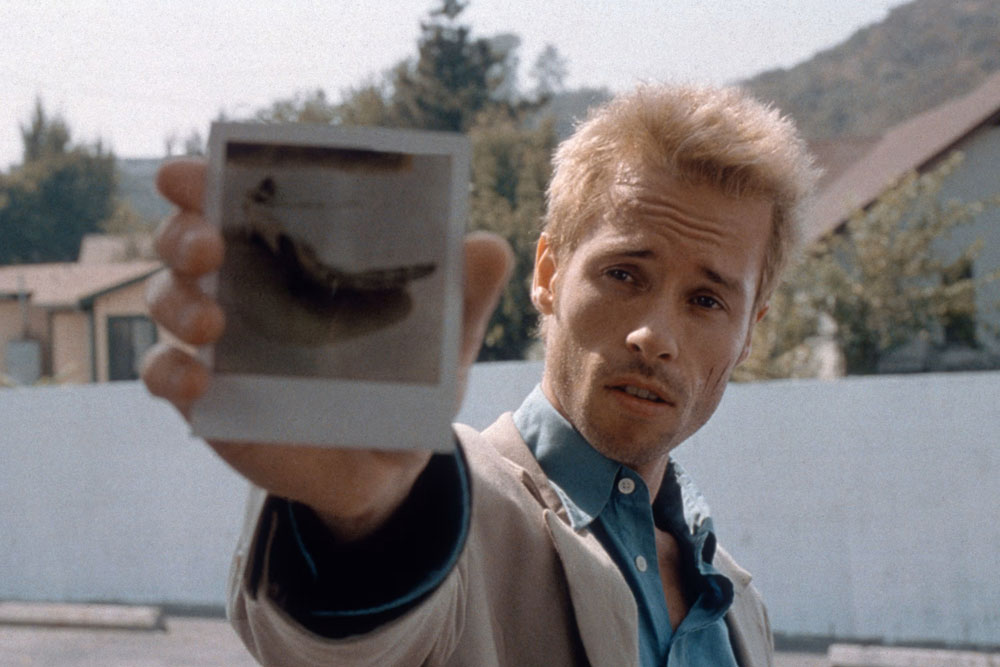
Memento (2000)
Director: Christopher Nolan
Starring: Guy Pearce, Joe Pantoliano, Carrie-Anne Moss, Stephen Tobolowsky
Ironically, memory played a big part in our rewatch of Christopher Nolan’s twisty, seedy neo-noir, Memento. Lorenzo couldn’t remember if he’d ever seen it (about halfway through, with a vague familiarity dawning, he indicated that he probably had), and Tom knew the film and remembered loving it, but realized upon starting it that he had no idea how it ends or where the story was going to go. We essentially got to re-experience it for the first time, albeit with the foreknowledge that the story was going to go to places unforeseen.
It might be useful to place Memento in the context of its times. At the turn of the century, Guy Pearce had received the highest critical and box office acclaim of his career after the success of LA Confidential (1997) and Carrie-Anne Moss was being positioned as the next big female star after the success of The Matrix (1999). Despite this, their co-star Joe Pantoliano (also hot off The Matrix and cast based on Moss’s suggestion) joked to the press that everyone was cast because they were the only people the filmmakers could afford. Brad Pitt had been originally on board to play the lead but eventually passed. Even so, the trio at the center of the film were considered either rising stars or well-established character actors. The film itself exists on a continuum of twisty thrillers of the period like The Sixth Sense or The Usual Suspects or Fight Club — “Everything you know is wrong” stories with twists that force the viewer to reconsider everything they’ve just seen. But the beauty of director and screenwriter Nolan’s story is that it forces the viewer to reconsider what they’ve just seen constantly, throughout the movie. The ending is the beginning and the beginning is the ending.
This is of a piece with Nolan’s entire filmography, which seemed at times obsessed with upending linear narrative structures or playing with multiple timelines. You saw this in The Prestige, Inception, Tenet, and even Oppenheimer, to a certain extent. Nolan has always loved to play with the audience’s memory and sense of time. This film, like a lot of his films, tends to be classified as a “puzzle box,” but we think Memento works best as an experience instead of as a problem to be solved. To be fair, there’s an entire quarter-century-old cottage industry devoted to explaining its structure and easter eggs and theorizing about countless hidden meanings. Nolan encouraged this kind of response in the filmmaking, including shots that seemed to contradict parts of the story (there’s one of Leonard in bed with his wife, with a chest tattoo that he doesn’t have in the rest of the film, indicating that he killed her attacker) or ones that are deliberately ambiguous (Was Leonard in an asylum at one point?). And while the film is a closed loop, ending more or less where it started, the fate of Leonard is left wide open, openly inviting the kind of theorizing that has surrounded the film for decades.
But when we say we think it should be experienced rather than solved, we mean that it’s more emotionally rewarding to allow Nolan’s timeline trickery and editing to do what it was intended to do: give the viewer the same experience of memory loss that Leonard is experiencing. While the structure of the film is impressively clear — it really only takes about ten minutes or so for the viewer to get a handle on the timeline– and Nolan uses a lot of visual or auditory cues to remind you of when things are happening (everything from facial injuries to new tattoos to broken windows), it’s still remarkably easy to wind up in the same kind of narrative fog that the lead character is experiencing. This is helped not just by the editing, but by Pearce’s somewhat disturbing affect and nearly monotone voice-over. But a film can’t leave the viewer in a fog for the entire run, and Nolan was smart about when and how he snapped our attention back into place.
This is the scene that the entire movie hinges on. This is the moment where you realize first that Natalie is that classic noir stock character, the femme fatale (language aside, Barbara Stanwyck could have played this exact scene beautifully a hundred times) and second, that Leonard’s condition is not under the kind of control he assumes and that he is painfully easy to manipulate. This is the moment where you start to question literally everything going on; whether Leonard is actually doing what he says he’s doing (looking for his wife’s killer) and whether the various people he’s coming into contact with have anything to do with that quest. Put bluntly, this is the moment when it becomes clear how hopelessly fucked up the whole situation is.
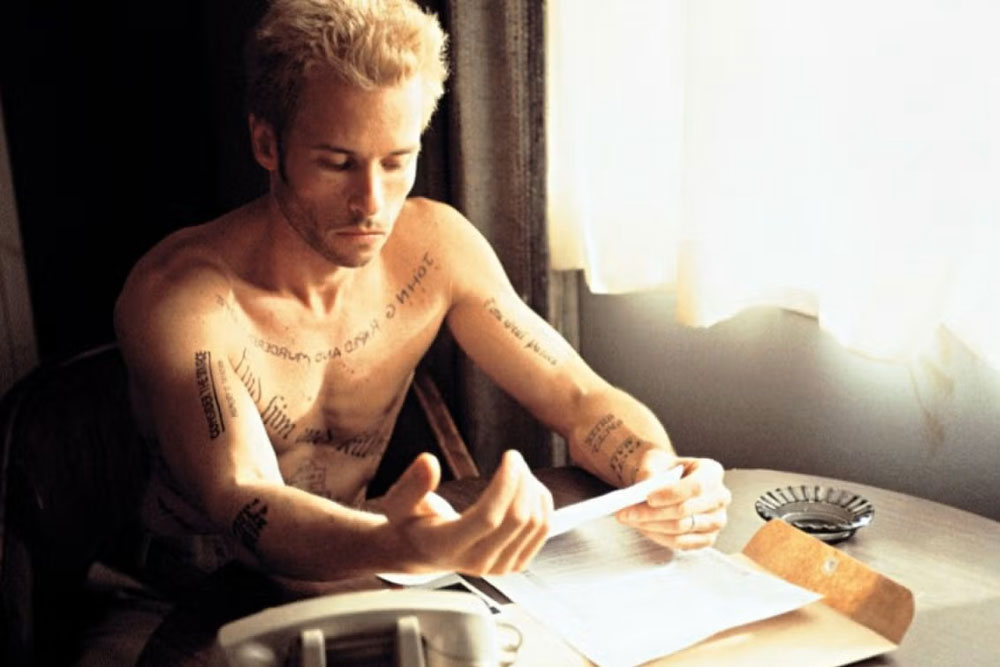
For a film by a straight male director and screenwriter with a story that isn’t about sex at all, Memento is extremely focused on the body of its male lead. And while the various tattoos delineating Leonard’s obsession are important to the story and to our understanding of how his life works, Pearce’s physicality informs the character nearly as much. His body is ripped, but not overly muscular, indicating a life of obsession, not a gym-goer’s results. Leonard barely eats or sleeps, probably because he only remembers to do so when he absolutely has to, and his condition and obsession almost certainly prevent him from fully indulging in either activity. We’ll amend the earlier description. Leonard isn’t ripped, he’s gaunt, wasting away because he’s caught in a cycle of loss and forgetting and vengeance. Pearce has always had that whip-thin, sunken-cheeked look to him, but Nolan puts it to excellent use, never missing a single moment where his shredded, tatted body is put on display, and it’s interesting to note when the film portrays him as sexually attractive and when he starts looking seedy and starving.
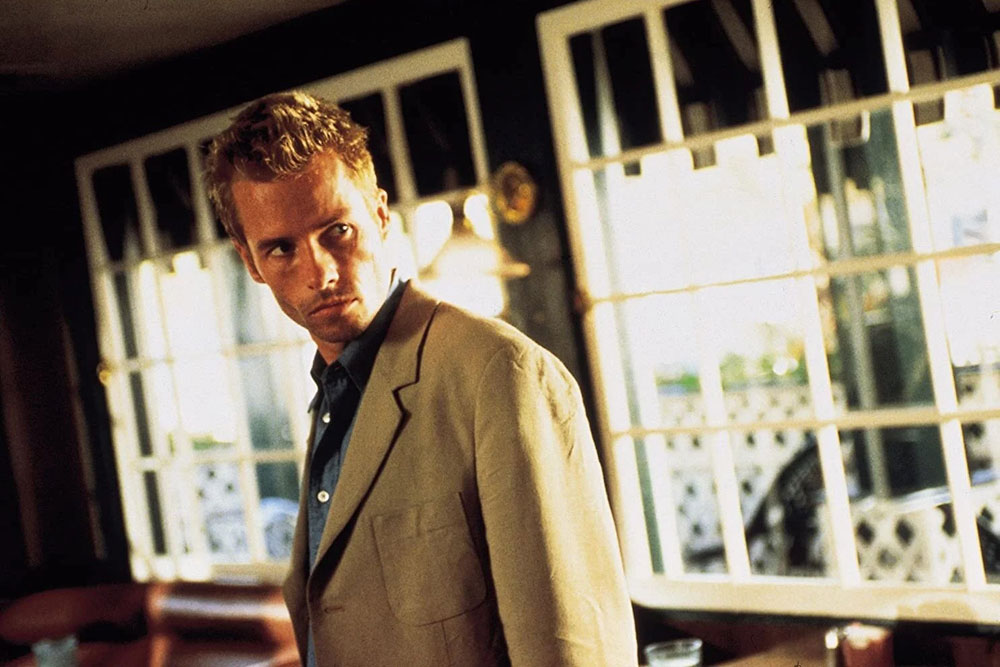
As for the costume design, about halfway through the film, we both noted that Leonard’s costume had that iconic quality that we’ve talked about with certain movie costumes — not because it’s instantly recognizable like, say, John Travolta’s white disco suit in Saturday Night Fever, but because the costume literally serves as an iconic representation of the character’s journey and state of mind. There are hints throughout the film that he’s wearing someone else’s clothes and driving someone else’s car, but it doesn’t become clear until the last few minutes of the film. As we’ve noted in our costume design writing before, if a character’s costume literally goes through a journey on film, it’s worth paying attention to what that costume is saying. In this case, the suit didn’t just travel through Leonard’s increasingly destructive time in the seedier parts of the San Fernando Valley (going from wrinkled and dirty in the film’s “earliest” scenes to gradually looking more pristine as the timeline progresses in reverse), it also travels from one person to another.
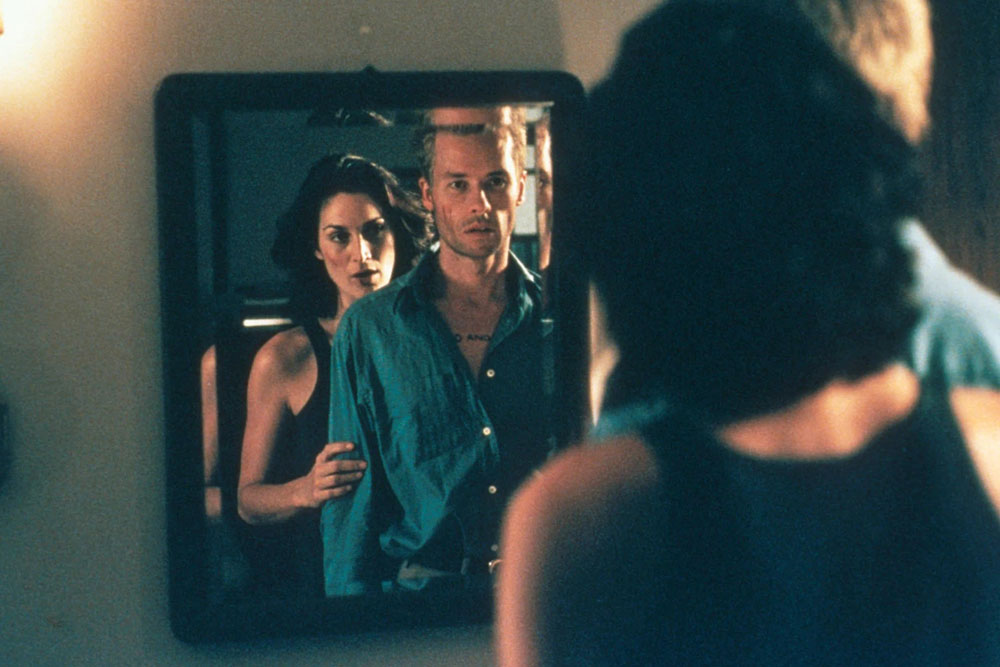
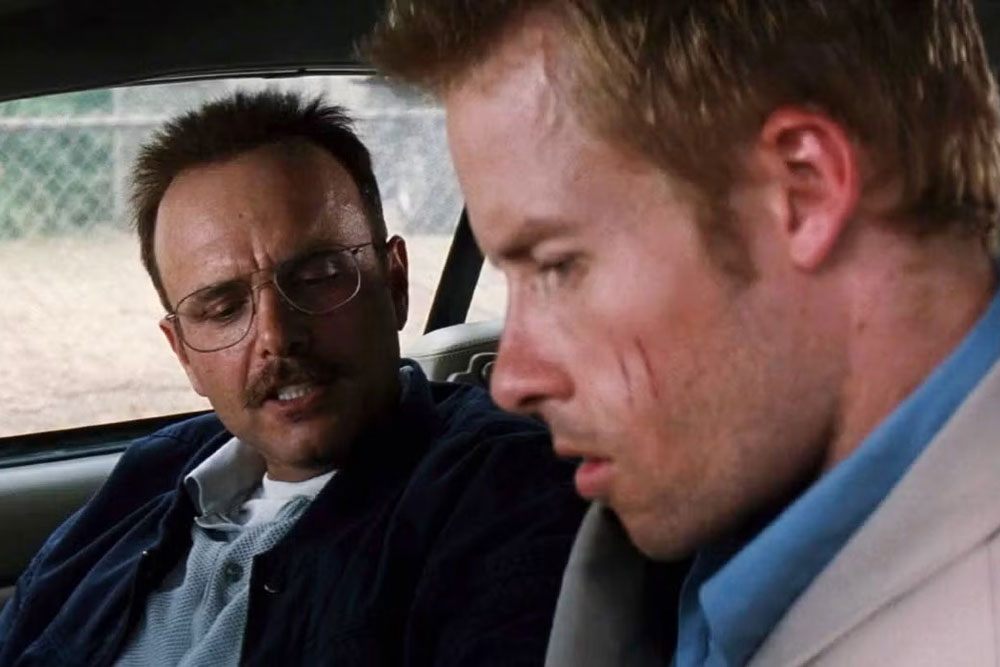
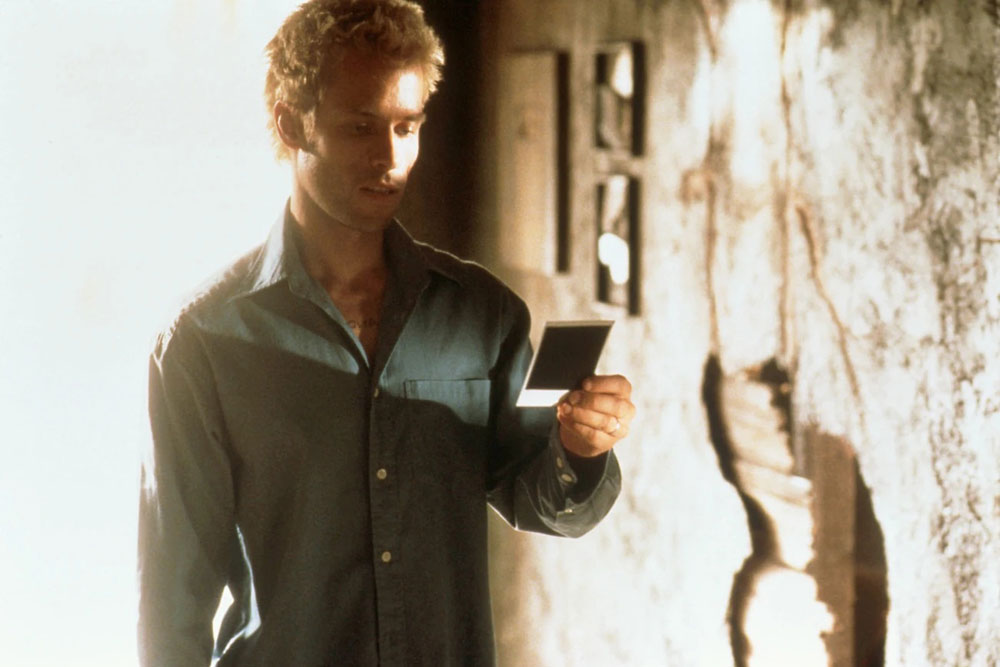
Costume designer Cindy Evans smartly used the loose cut of the suit to underline both Leonard’s diminishing form and the fact that the suit actually doesn’t belong to him. The tan and blue color story of the costume gives Leonard, with his bleached hair and piercing blue eyes, a weirdly uniform visual, and when drug dealer Jimmy first appears wearing the outfit, you can tell that the costume designer chose it for Guy Pearce and not for the other actor. You can also see how Brad Pitt’s ghost kind of hangs over the concept of the look, since this is pretty much exactly how he looked at the time. The blue of his shirt recurs as a motif throughout the production design; in hotel rooms, bars, motel signs and other character’s clothing. There’s also a highly defined sense of communion between the costume design and the production design; not just the way blue plays out over and over again in the surroundings, but how Pearce’s whole look seems to blend in with the blasted-out and seedy surroundings he finds himself in. Note how the film rarely shows any people who aren’t directly involved in the story. One or two bar or diner patrons, but for the most part, Leonard is adrift in a world all his own, alone and indistinguishable from his surroundings, not even aware that he’s wearing the clothes of the man he killed.
More thoughts in this week’s BKMC pod:
Additional Material:
BAMF Style: Guy Pearce in Memento
Christopher Nolan explains Memento
Next Week:
Previous BKMCs:
Marie Antoinette (2006)
The Greatest Showman (2017)
Nouvelle Vague (2025)
[Photo Credit: 20th Century Studios]
Previous post:
APEX Star Charlize Theron in McQueen on LATE NIGHT WITH SETH MEYERS Next Post:
Catherine, Princess of Wales Commemorates ANZAC Day in Givenchy
APEX Star Charlize Theron in McQueen on LATE NIGHT WITH SETH MEYERS Next Post:
Catherine, Princess of Wales Commemorates ANZAC Day in Givenchy
-
RUPAUL’S DRAG RACE ALL STARS: SHOP TIL U DROP
-
The Bitter Kitten Movie Club: DOLEMITE IS MY NAME (2019)
-

RUPAUL’S DRAG RACE ALL STARS: BREAK DANCIN’ 2 ELECTRIC RUGALOO | BAR QUEEN COUTURE
Please review our Community Guidelines before posting a comment. Thank you!
