
Wings of Desire (1987)
Director: Wim Wenders
Starring: Bruno Ganz, Solveig Dommartin, Peter Falk, Otto Sander, Curt Bois, Nick Cave
“Als das Kind Kind war,
ging es mit hängenden Armen,
wollte der Bach sei ein Fluß,
der Fluß sei ein Strom,
und diese Pfütze das Meer.”
“When the child was a child
It walked with its arms swinging,
wanted the brook to be a river,
the river to be a torrent,
and this puddle to be the sea.”
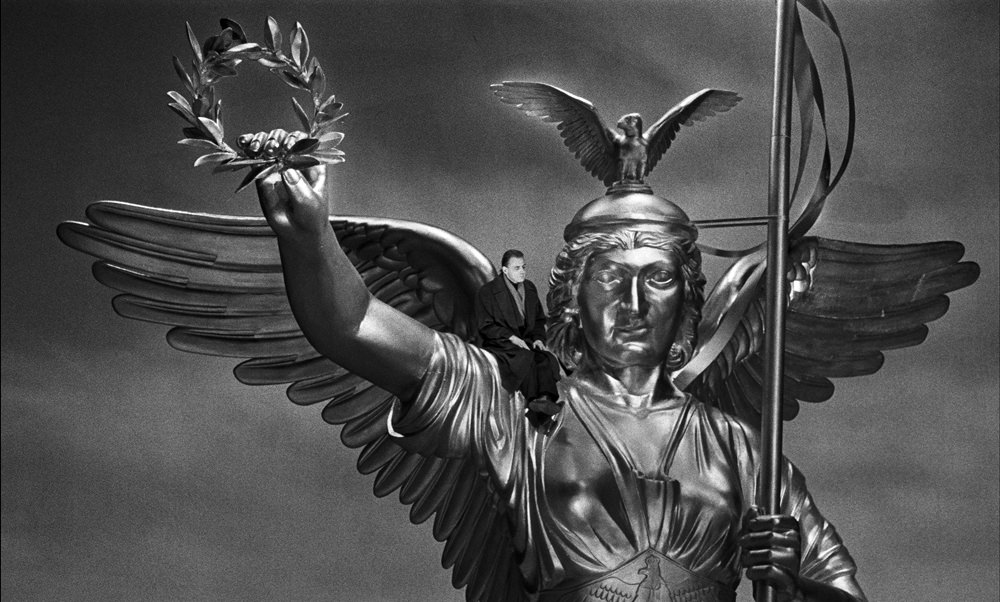
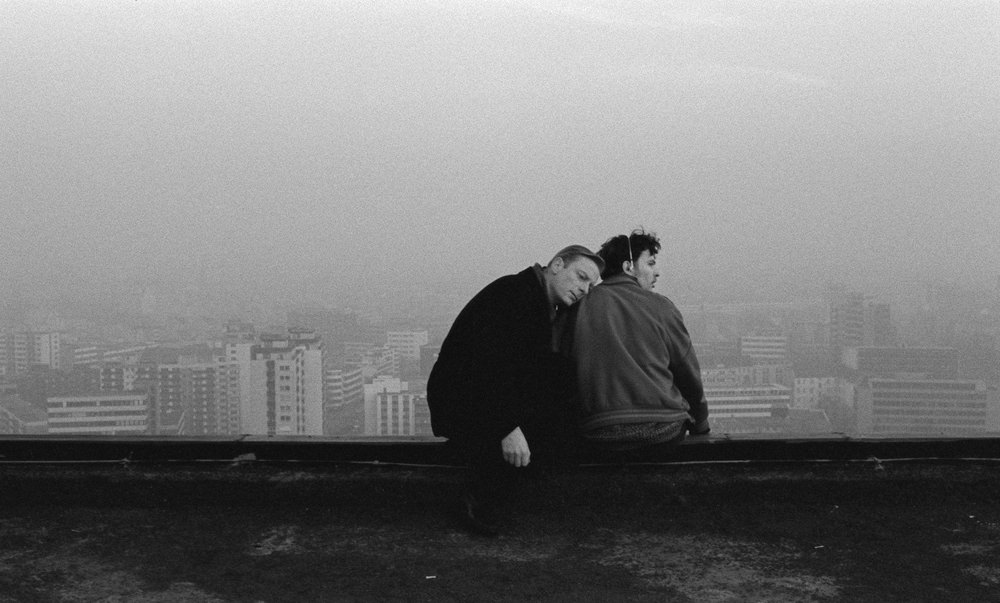
We wanted to open this essay the same way director Wim Wenders begins Wings of Desire, partially because the poem, written for the film by Austrian poet Peter Handke, is simply beautiful in either German or English (more so in German, we think) and partially because it’s so good at setting the film’s dreamy, poignant, elegiac, and wistful tone. Wings of Desire, as trite as it might seem to say it, is a film about life itself; about childhood, dreams, yearning, time, love, and death. To explore these themes, Wenders settled on angels as our guides; not the spear-wielding, armored archangels of Renaissance paintings but gentle, chic beings with beautiful coats and hair, gently observing and silently trying to offer comfort to a city teeming with memories. The idea that there are beings who observe your every thought and action with extreme care, who will press their foreheads to yours or put a hand on your shoulder when you are struggling, is so comforting a thought that it sends you right back to your childhood. Kind, friendly beings that only you can see, that care about you to an extent that almost seems obsessive.
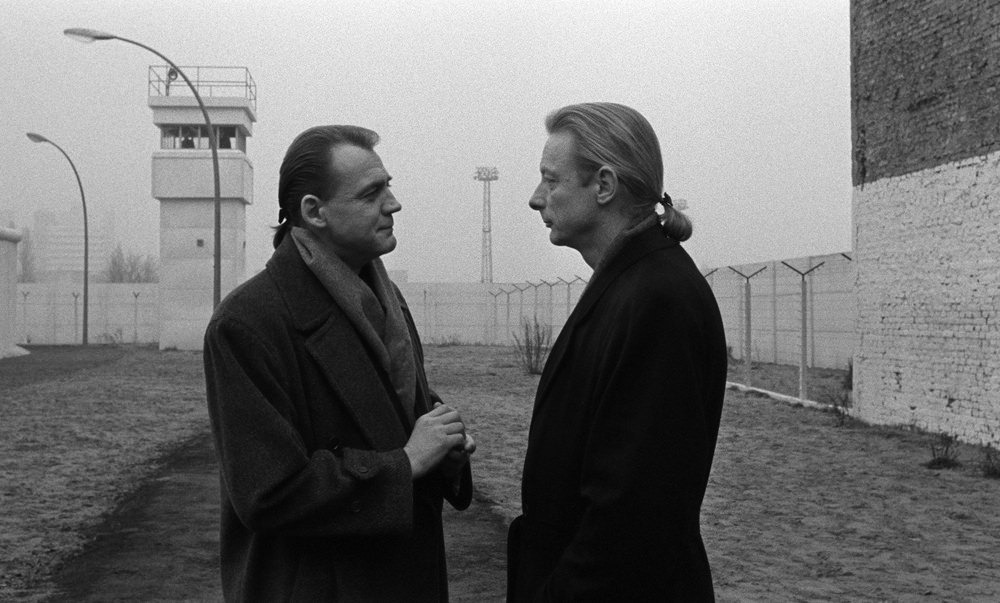
It’s also a love song and eulogy for a city. Wenders clearly wanted to film a sort of ode to (West) Berlin, but he also inadvertently created an ode to the decade in which the film was made. Stunningly shot in both color and black-and-white by cinematographer Henri Alekan, Berlin almost feels like a living, breathing thing in this film, albeit a living thing with wounds that don’t seem capable of healing; old buildings with roofs missing, vast stretches of demolished nothingness, memories of the war and the price Germany paid for it at every turn, Berlin is a city full of angels and pilgrims and yearners, but it’s also an old man wandering No Man’s Land, looking for a past to which no one can return.
It’s a shaggy film; less interested in linearity or plot than it is in improvisation and experiences. There are times when the pacing gets away from Wenders, when it becomes obvious that he just wanted to keep the camera on his girlfriend Solveig Dommartin while she did the trapeze routine she spent weeks rehearsing or on Nick Cave while he does his rock star turn or on Peter Falk while he tries on a bunch of hats. But if these stretched-out moments bore the viewer, they also serve to shine a spotlight on how beautiful the mundane can be. One of the best scenes in the film is just Damiel and Cassiel, sitting in a convertible and comparing notes on all the silly, strange, wonderful things human beings sometimes permit themselves to do, while they watch life pass by on the street. Still, there’s no denying that the film has a looseness to it that sometimes works in its favor and sometimes doesn’t. To give you an idea of just how loose, check out the deleted scene that included a pie fight between Damiel and Cassiel. Wenders was throwing everything at the wall to see what worked, and it’s something of a miracle that he pulled together an honest-to-Gott masterpiece out of this rag-tag method of shooting.
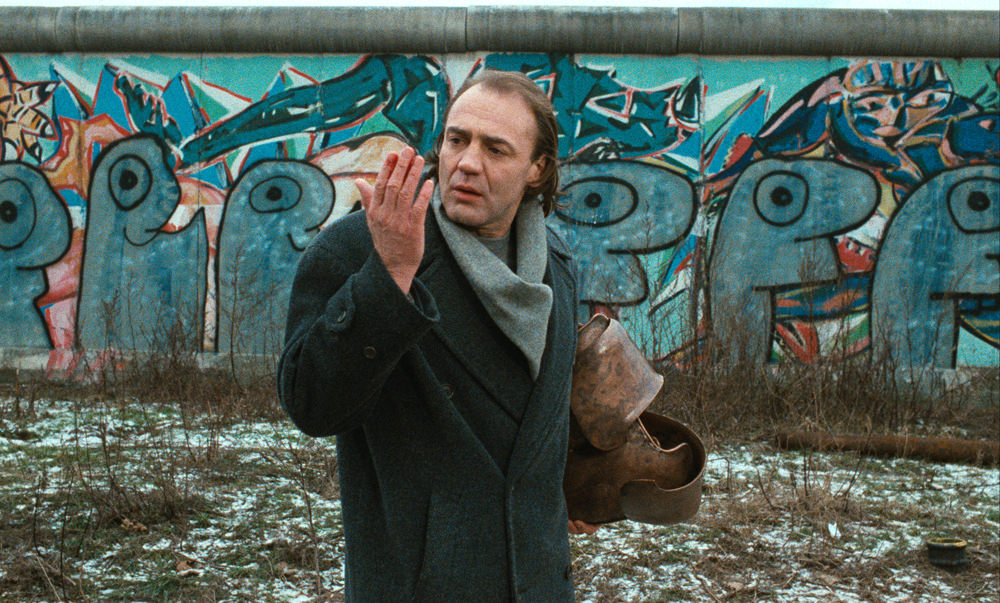
One of our favorite aspects – and a tribute to Bruno Ganz’s skill as an actor as well as Wenders’ skill as a director – is the way the film suddenly shifts in its depiction of Damiel as soon as he becomes human. Ganz’s performance changes from one of stoic passivity to one of awkward discovery and Wenders signals that by focusing on his bald spots and letting his discolored teeth fill the frame. Damiel, no longer apart from his desires or humanity, reveals a goofy, dorky demeanor, his beautifully simple coat traded for an eyesore of ’80s fashion. To be human is to be messy, and this film revels in that idea.
With its living memories of the War, the starkness of No Man’s Land and the Cold War, the stunningly vibrant graffiti, and even a killer set by Nick Cave and the Seeds, Wings of Desire couldn’t be more eighties if it tried. In the nearly forty years since the film debuted (a duration analogous to the time from the end of the War to the filming itself), it has morphed from an elegiac musing on childhood, live and love to a time capsule of the last days of the Cold War and what it was like to live there. Beauty in the ruins, artwork on the rubble. Wenders’ love of Berlin is evident in nearly every frame, but he loves it for its scars and wounds as much as he loves it for its people and monuments. To give the black-and-white scenes that dreamy, half-hidden quality, cinematographer Henri Alekan reportedly settled on using an old stocking of his grandmother’s as a camera filter, in order to produce the kind of diffuse lighting that lend scenes their dreamlike feel; a detail that seems almost too wonderfully poignant to be true. We hope it’s true. A memory shot through a memory.

After Damiel becomes human, there’s a long tracking shot of him walking down a treeless, joyless street, nevertheless full of joy himself. Today, that street is almost certainly full of trees, Starbucks and high-end shops in a unified Berlin, and part of the poignancy of this ode to a city is that it mourns the city that was lost while depicting a city that has since been lost. Nothing is more shocking than watching the scenes of the old man wandering through what used to be the Potzdamer Platz, musing on everything that was lost with the War and then going to look at pictures of it today, in a unified Germany of the 21st Century, its wounds sutured to the point of invisibility. The muddy lot where Marion’s circus troupe plied its trade and elephants stood on their heads is now a city park with a gorgeous mural in tribute to its one-time inhabitant. Time moves on. The children at that circus are all well into their middle age. The young man whose parents fretted over his music is now a grandfather. The lead actors are all dead. A film partially about looking for the things that were lost by time is now full of things lost by time.
More thoughts in today’s BKMC pod, and as we predicted last week, Tom can’t even talk about this film without getting choked up.
Further Reading:
“Song of Childhood” by Peter Handke
YouTube: The Making of Wings of Desire
Janus Films press book for Wings of Desire (pdf)
Next Week: Dolemite Is My Name
[Photo Credit: Courtesy of Janus Films]
Previous post:
Style File: Eiza González Promotes IN THE GREY in New York Next Post:
T LOunge for May 11th 2026
Style File: Eiza González Promotes IN THE GREY in New York Next Post:
T LOunge for May 11th 2026
-

Bitter Kitten Movie Club: ATONEMENT (2007)
-

The Bitter Kitten Movie Club For June 2026
-

The Bitter Kitten Movie Club: TO DIE FOR (1995)
Please review our Community Guidelines before posting a comment. Thank you!
