
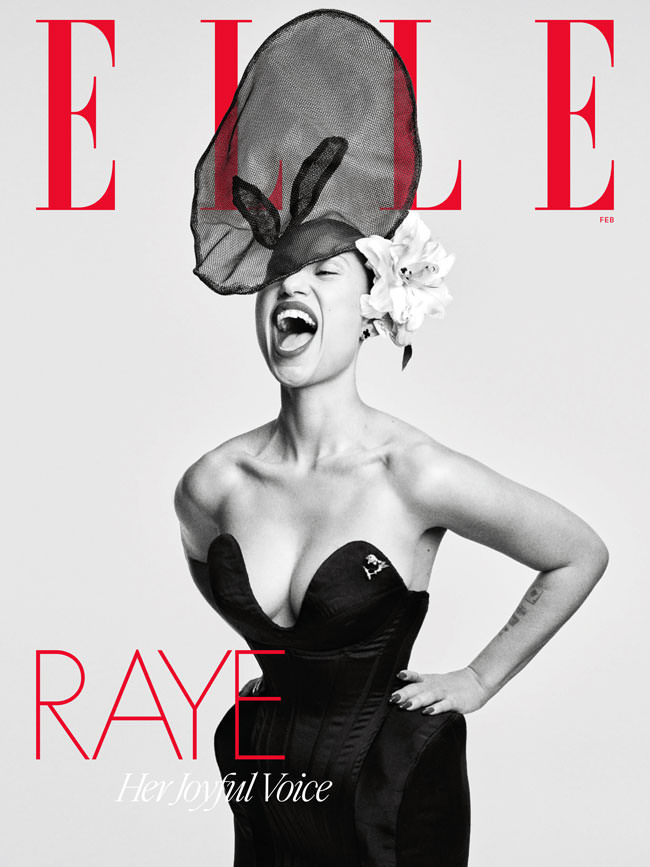
British sensation Raye covers the February 2026 issue of ELLE, her first major US magazine cover story, on newsstands February 3.
In an exclusive interview with ELLE Deputy Editor and Features Director Kayla Webley Adler, Raye opens up about how life has shifted since entering a bigger spotlight, the push to expand her presence in the US, and gives ELLE an exclusive look at her highly anticipated second studio album: It’s a dramatic opening, followed by an even bigger bang when track one, “I Will Overcome,” comes on. Backed by an orchestra, the song is “big and dramatic, and unapologetically so,” she says. “There’s a lyric in there that says, ‘Aren’t we all broken people?’ We just perfect how to hide it. But it’s life’s guarantee that we’re all going to die. So am I going to live like this all of my life? I’m not okay right now, but I’ll get there somehow. I’ll overcome.”
She also opens up about addressing Amy Winehouse comparisons on her new album: “What’s difficult for me is when people are so horrible, rude, nasty, and evil with their words, ‘You’ll never be her. You are an absolute failure. You disgust me trying to think that you could even be remotely like she was.’ And it’s like the funny thing to me about the way they’re speaking to me is, it’s that same evil. I’m not saying I’ve experienced even a hundredth of what that girl was put through, but it comes from a similar place. Our beloved Amy would probably still be here today if she didn’t have to be subject to all this hate when she was alive. … So it’s quite an intense thing to address so early on in this album, but I felt in my heart that I really wanted to.”
Following her historic BRIT Awards sweep and several new Grammy nominations, Raye also reflects on her early beginnings in the industry, the pressure of heightened public scrutiny, overcoming her struggles with substance abuse and embracing the power of positive affirmations: “Words are so powerful, and we speak things over ourselves and it becomes part of our identity,” she tells me, adding that she’s now forbidding herself to say anything negative about herself, even in her internal thoughts. “You say, ‘I’m brave and I’m strong,’ and you are then making that your identity, instead of, ‘I’m a victim, I’m broken, and I’m never going to be okay again.’ We are not going to let other people decide our futures. I’m not going to let you steal my hope and my joy. Absolutely not.”
Her new album, and music more broadly, she says, has ultimately become a source of healing for her: “Music is medicine. I’ve always said that,” she says. “And I guess I’m in the process of making medicine for myself that I can share with the world. I want us all to say to ourselves that it’s going to be all right, and I’m going to have faith in the seeds that I’ve planted beneath the snow. I wanted to create something that is a hug or bed or soft place for that person who needs it.”
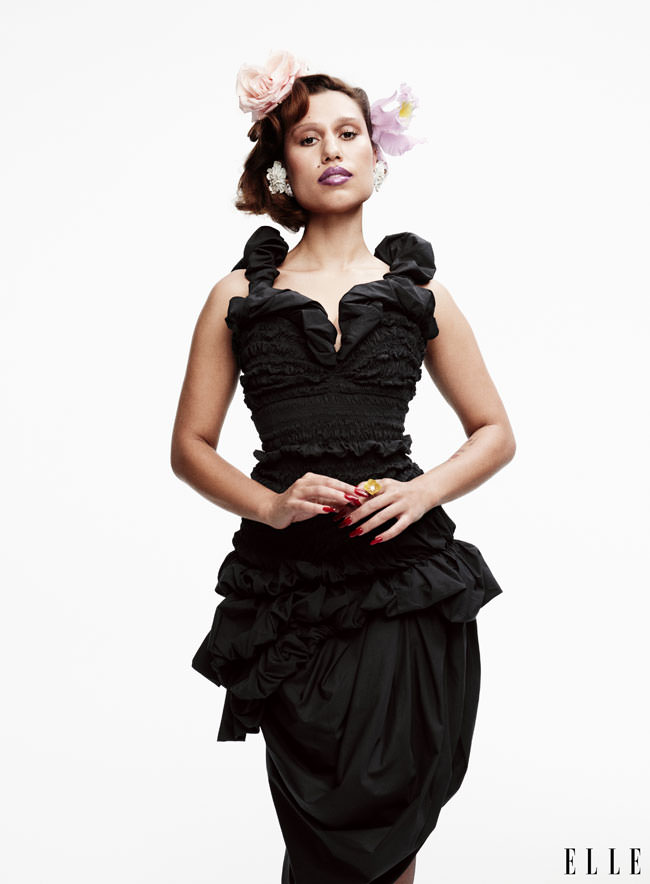
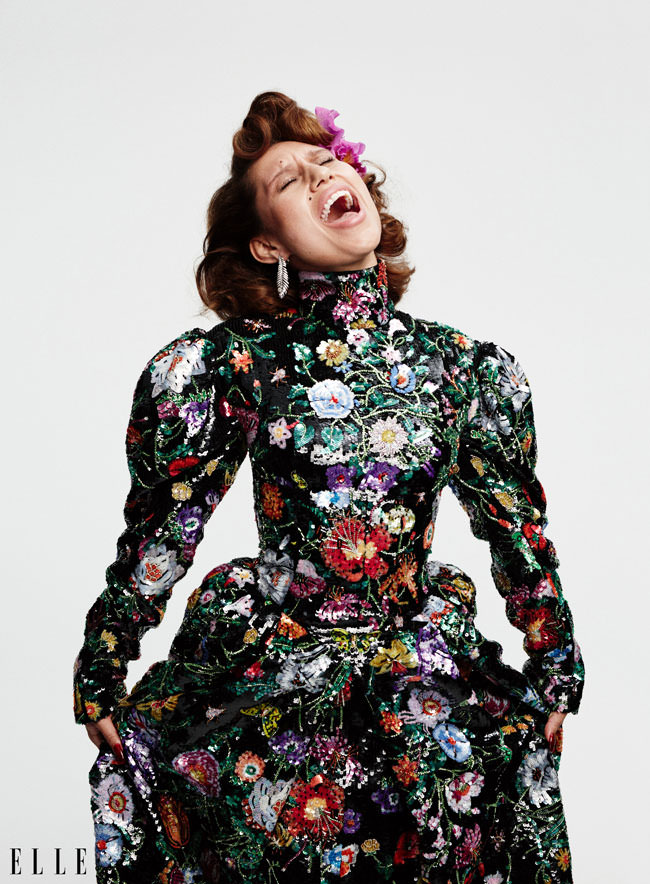
On ELLE being her first major US Magazine cover story: “This really is the big dream,” she says, “to make a name for yourself in this huge country.” With the success of “Where Is My Husband!,” she says, “Chapter Two is off to an exhilaratingly amazing start.”
On her upcoming sophomore album: “I don’t want this album to feel like it was made in a studio,” she explains. “I want it to feel like it was informed by the live experience.”
On entering the music industry: The way Raye tells it over dinner is, “I was 14 years old when I met my first manager, and I started doing sessions, and I was whisked into this world of just being….” She pauses, searching for the right words. “I went through some really traumatic things as a child.” She signed her first record deal in 2014 when she was 17: a four-album deal, a contract full of language she didn’t understand. “I really was a baby,” she says. “I really was a child.”
On unpacking her experiences in the industry: “A lot of damage had to be repaired from my old life, where I was entirely disconnected from my family. You see how close I am with my family now—that’s my center point. But I was a world away from that,” she continues. “I was a very different person to who I am now, even though I may present the same or be able to put on the mask and play the part.”
On lessons learned from her first tour: She marvels at how far she’s come since her first tour, recalling one show, in St. Louis, which was only about a quarter sold. She learned to focus on the people who did show up, not on the empty space. “It was disheartening. I was really upset, but it’s important to feel those things, to go through the steps,” she says. “You’re able to build resilience as well.”
On releasing My 21st Century Blues after parting ways with her label: As an independent artist, she was free to span genres—R&B, jazz, club, soul—and sing her truth on a wide range of issues from sexual assault, disordered eating, and addiction, to social media and climate change, even former Prime Minister Boris Johnson’s coke use. “Why are we not talking? There’s this huge list of things that are embarrassing and scary and terrifying to talk about—the dark, the twisted, the ugly, the trauma—and if not music, then where?” she posits. “As hard as I do find it—because you see those moments in your head that you run from—I want to be an artist who can put words to something that hurts so much.”
On writing her upcoming album with a clearer head: “A lot of My 21st Century Blues, I was up in the clouds, rolling a blunt,” she says. “I like that I’ve come down to earth to write these lyrics. I prefer myself like this. I’ve found discipline and abstinence in my life, and it’s a beautiful thing. I’ll have a nice glass of wine every now and then, but I’m no longer drinking to fix or bury or numb or escape.”
On overcoming her struggles with substance abuse: “I’m really proud of the growth I’ve done, because there’s a period in my life where I wasn’t interested in going on,” she says. “And I know a lot of people out there go through that. I would never dream of giving up on myself like that today.”
On the making of “Ice Cream Man”, a song about her experiences of sexual assault, one incident involving a music producer: “I made it because I needed to put words to everything that I was dealing with,” she says. “And actually that was the song that allowed me to talk to my parents for the first time about what I’d been through across my childhood and adolescence and teenage years, trying to make it as a musician. So music is that safe space for me.”
On performing her song “Ice Cream Man” at the BRIT Awards: “It was important to me,” she tells me of the decision to perform it for a room full of music executives. “It was something medicinal and cathartic I needed to do for myself, to sing that song on that stage—to open with it—and be really loud about it. It allowed me to feel so powerful.”
On prioritizing herself over romantic partners, for now: “I know there’s going to come a time where I’ll be surrounded with people and family. I want to have kids one day. I want to do all of those beautiful things, but I know that before I’m ready to meet anyone, I need to find myself first. I don’t want someone else to come and fix me. I want to meet someone as the best version of myself.”
[Photo Credit: Willy Vanderperre for ELLE Magazine]
Previous post:
Milan Fashion Week Front Row: Luis Vuitton Fall 2026 Menswear Fashion Show Next Post:
Style File: Claire Foy Promotes H IS FOR HAWK in New York
Milan Fashion Week Front Row: Luis Vuitton Fall 2026 Menswear Fashion Show Next Post:
Style File: Claire Foy Promotes H IS FOR HAWK in New York
-
Kaia Gerber Talks Her Upbringing, Cindy Crawford and Budding Acting Career for HARPER’S BAZAAR Magazine
-

Yerin Ha on BRIDGERTON Leading Role, Intimacy Scenes, and Breaking Barriers for INSTYLE Magazine
-
HAMNET Star Paul Mescal for British GQ Magazine
Please review our Community Guidelines before posting a comment. Thank you!
